For a little while, the way to safety was a rope tied to a rock.
The Delaware left Nelson for Napier on 3 September 1863. By the following morning she was on the rocks at Whakapuaka, with a gale driving the sea against her.
Her first mate, Henry Squirrel, tried to take a light line ashore. If he could get it there, they could use it to pull a heavier rope across.
He struck the rocks. His shipmates hauled him back aboard, badly injured.
On shore, people from Whakapuaka had seen the trouble and come to help.
Hūria Mātenga was there with her husband, Hēmi. The local account also names Hohapata Kahupuku, Eraia and Kerei.
Five people, with a wreck in front of them.
A light line was caught and a stronger rope hauled ashore and made fast to a large rock. The men on the ship could now work their way along it towards the beach.
The rope rose and fell with the ship. Sometimes it dropped them into the water.
Hūria, Hēmi and Hohapata went back into the surf to help them through. Eraia worked to keep the rope clear of the rocks. Kerei lit a fire and looked after the men as they reached land.
That is the part of the story I keep coming back to. Someone in the water. Someone on the rope. Someone making a fire for the next man to reach the beach.
The first line is one of the uncertain parts. Accounts differ about exactly who caught it and how it was brought ashore. I have left that open rather than give one person a swim the records cannot settle.
Henry Squirrel was still on the ship. The others believed he was dead when they left him.
Later, he appeared on deck and called for help. By then the rope had gone. He was washed overboard, and his body was found the next morning.
The inquest found that his injuries had prevented him from reaching shore by the rope. It called for public gratitude and a substantial reward for the people who had saved his shipmates.
Henry belongs in the telling too.
Nelson presented Hūria with a gold watch and chain. The men received silver watches and chains. The gifts had been paid for by public subscription, and the government gave money as well.
The English inscription on her watch began "Presented to Julia". The Māori inscription named Hūria.
At the presentation she was compared with Grace Darling, the English woman famous for another sea rescue. That comparison followed Hūria into the newspaper accounts of her life.
There are plenty of words about her in those papers. What I would like to find is her own account of that morning.
Has anyone come across something Hūria herself wrote or dictated about the Delaware rescue?
Sources are in the comments.
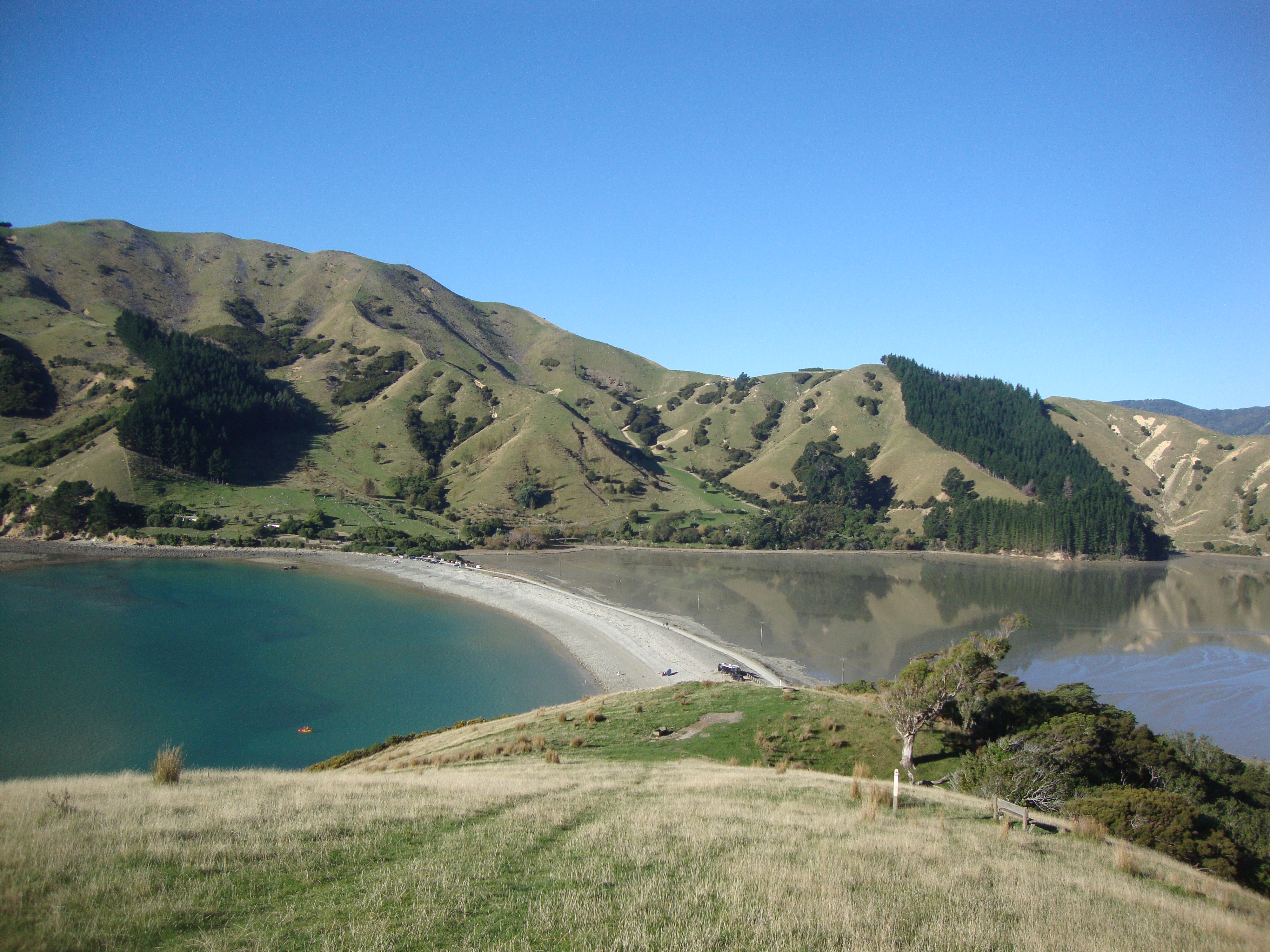
A modern view of the neighbouring coast. This photograph does not show the 1863 rescue, and no rock or beach pictured here is identified as the wreck site.
Photograph: Schwede66, "Causeway to Pepin Island 82", CC BY-SA 3.0, via Wikimedia Commons:
https://commons.wikimedia.org/wiki/File:Causeway_to_Pepin_Island_82.JPG
Licence:
https://creativecommons.org/licenses/by-sa/3.0/
Image unchanged.
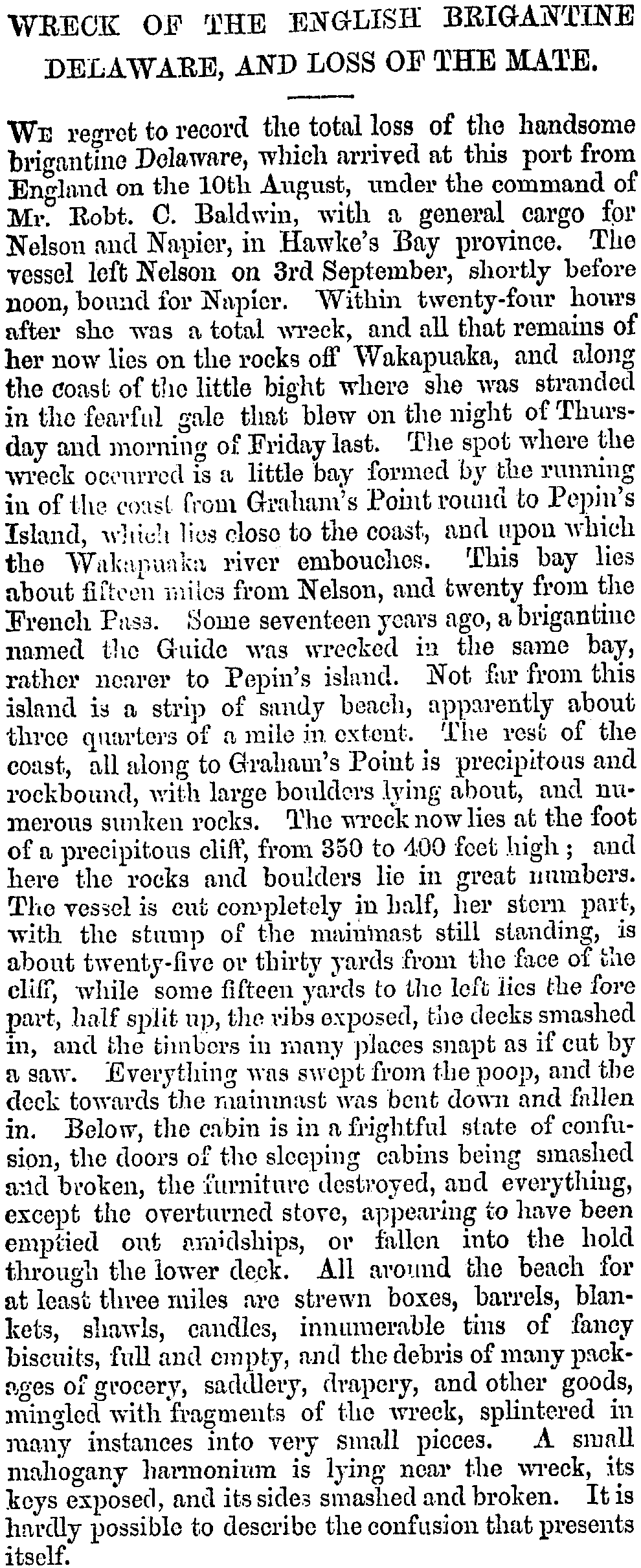
Source: Papers Past, National Library of New Zealand. Colonist, volume VI, issue 614, “Wreck of the English Brigantine Delaware, and Loss of the Mate.”
https://paperspast.natlib.govt.nz/newspapers/TC18630911.2.36
Facsimile excerpt from the digitised page. The provider labels this item “No known copyright (New Zealand)” and expressly permits reuse, including commercial use.
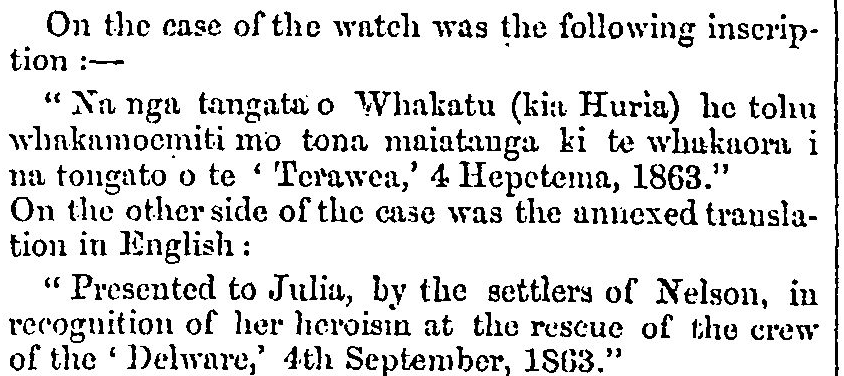
A facsimile excerpt of the printed report. The newspaper’s publication date does not establish the presentation date.
Source: Papers Past, National Library of New Zealand. New Zealand Herald, volume I, issue 5. Digitised in partnership with Auckland Libraries and NZME.
https://paperspast.natlib.govt.nz/newspapers/NZH18631123.2.13
The provider labels this item “No known copyright (New Zealand)” and expressly permits reuse, including commercial use.
◆