Henry Williams wrote her name on the Treaty sheet. The mark beside it was hers.
In the middle column of the Cook Strait sheet, below the name Te Wiwi, are two small shapes. Beside them is the name Topeora.
That is Te Rangitopeora.
Archives New Zealand identifies the mark as hers. NZHistory records that Williams wrote the name. Two people had a hand in that small entry, and you can still see the part each left behind.
The whole sheet is worth a look. There is a double border around it, with the Treaty text above the names and marks arranged in columns below. Some entries are written names. Others have a shape beside them. The paper has fold lines across it, but the marks are still there.
A journey brought this sheet to her.
Williams left the Bay of Islands in April 1840 with two Māori-language copies of the Treaty. One went to his brother William at Tūranga, now Gisborne. The other travelled with him to Cook Strait.
At Port Nicholson he had difficulty getting rangatira to sign. A meeting aboard the schooner Ariel followed. He then took the sheet across to the top of the South Island, gathering signatures in Queen Charlotte Sound and at Rangitoto ki te Tonga, D'Urville Island.
By 14 May he was back on the Kāpiti coast.
Te Rauparaha's name is on the sheet. So is Katu, the name written by his son Tāmihana. Then there is Te Wiwi, the name written by Hēnare Mātene Te Whiwhi.
Te Rangitopeora's son.
Look at the entry below his. His mother is there too, with her own mark beside the name Williams wrote for her. Mother and son are on the same sheet, each recorded in a different hand.
Her story had already travelled a long way by then.
The biography written by Teremoana Sparks and W. H. Oliver places her birth at Kāwhia, probably early in the nineteenth century. Her mother was Waitohi, of Ngāti Toa and Ngāti Raukawa. As a young woman Te Rangitopeora migrated south to Kāpiti and the nearby mainland coast.
She was a composer of waiata and a leader who spoke at meetings. Her biography describes her part in making peace between Ngāti Tama and Ngāti Toa. It also records her part in the violent conflicts of that time. There is a substantial life behind the little space her name occupies here.
Later, at Ōtaki in 1847, she was baptised with the name Te Kuini, the Queen. That was the name she wanted. She became known as the Queen of the South.
On this sheet from seven years earlier, she is Topeora.
What strikes me is how much of a person can sit behind a name you might pass over. You can read the familiar names and keep moving, then stop at a mark and find someone whose own words you want to hear.
Archives dates her signing to 14 May 1840 and says possibly at Kāpiti. I have kept that qualification. I haven't found an account of what she said when she made her mark, or a reliable explanation of the shapes themselves. The sheet gives us her entry, and leaves those questions open.
Her son's written name helps us find the place. The official signatory list helps us identify her. Then the paper gives us something very small and direct to look at, the mark she made beside her name.
Has anyone found a letter or diary account that records Te Rangitopeora's own words at the signing of this sheet?
Below Te Wiwi, her mark is still there.
Sources are in the comments.
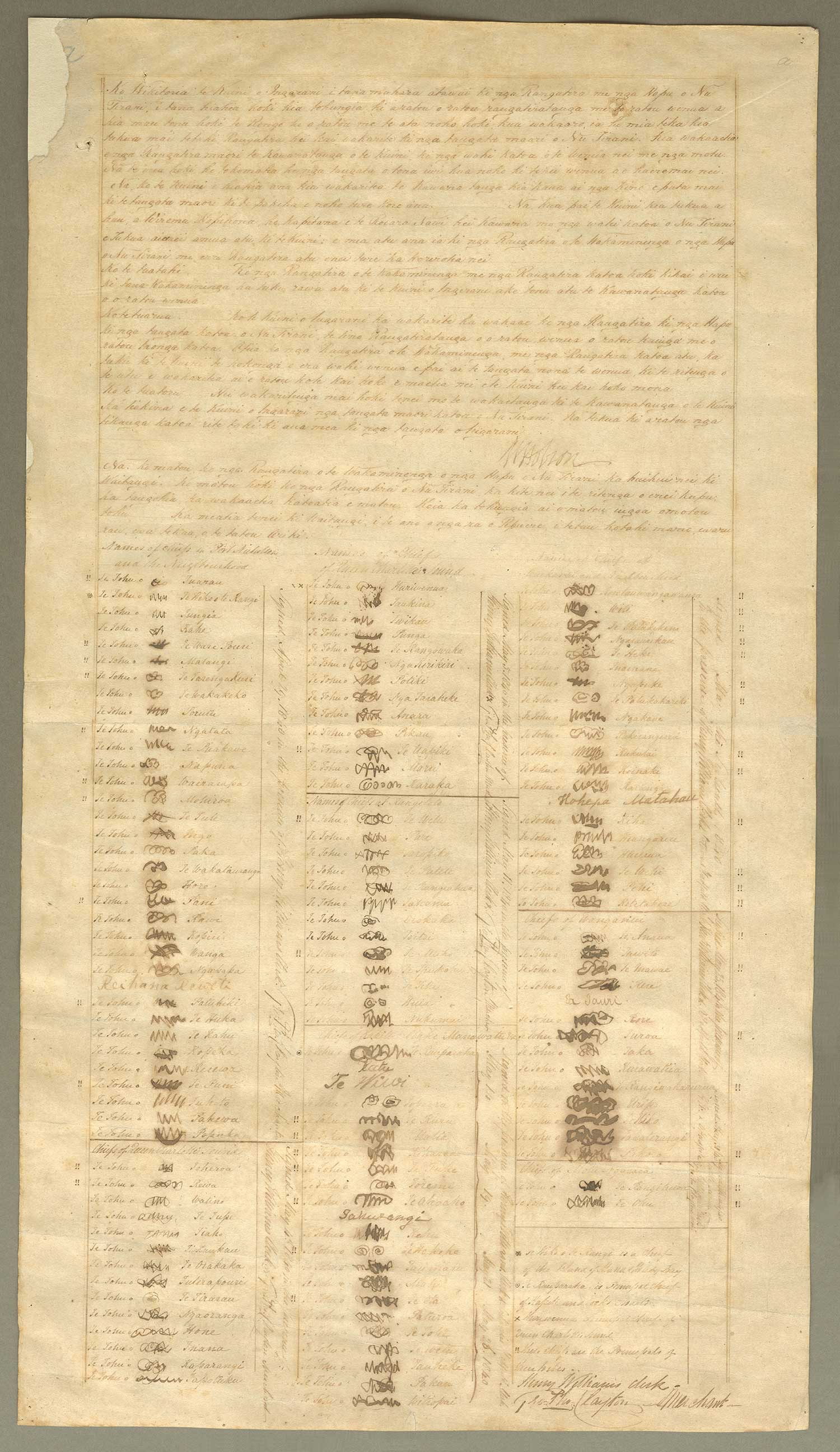
Archives New Zealand Te Rua Mahara o te Kāwanatanga, IA9/9 Sheet 8. Unaltered reproduction.
Source: https://www.flickr.com/photos/archivesnz/12195249795/in/album-72157640803885745/
Licence: CC BY-NC-ND 2.0, https://creativecommons.org/licenses/by-nc-nd/2.0/deed.en
◆